
In a world where staying connected is as essential as breathing, mobile antennas are the unsung heroes of modern communication. These nifty little devices work tirelessly behind the scenes, ensuring that texts, calls, and memes fly through the air with the grace of a gazelle. Ever wondered how your phone manages to keep up with your social media cravings while you’re on the go? Spoiler alert: it’s all thanks to mobile antennas.
Imagine trying to catch up on your favorite show while stuck in traffic, only to realize your signal’s weaker than your morning coffee. That’s where mobile antennas come in, turning frustration into seamless streaming and crystal-clear conversations. So, buckle up as we dive into the fascinating world of mobile antennas, where technology meets connectivity in the most delightful way.
Overview of Mobile Antennas
Mobile antennas play an essential role in facilitating communication across various devices. They serve as the link between mobile networks and users, translating electromagnetic signals into data. Mobile antennas come in diverse types, including dipole, monopole, and patch antennas, each designed for specific applications and enhanced performance.
Frequency bands determine how well each antenna type operates. For instance, antennas optimized for high-frequency bands excel in urban areas with dense populations, while lower frequencies more effectively penetrate obstacles in suburban and rural settings. A comprehensive understanding of these frequency ranges aids users in choosing suitable antennas for their needs.
Factors such as gain and directivity further influence performance. Gain indicates how much an antenna boosts signal strength, while directivity defines how focused the radiation pattern is. Higher gain often leads to better performance but may limit the coverage area. Several applications benefit from these characteristics, such as mobile phone networks, IoT devices, and vehicular systems.
Materials used in antenna construction also impact efficiency. Common materials include copper, aluminum, and specialized composites. The choice of materials can affect durability, weight, and overall performance, leading to improved longevity for mobile devices.
Technological advancements continue to shape mobile antennas. Innovations like MIMO (multiple input, multiple output) technology enable simultaneous data streams, enhancing connectivity for multiple devices. Rising demands for faster data rates and reliable connections drive the development of next-generation antennas that meet these needs.
Understanding mobile antennas helps navigate the complex world of connectivity. Users gain insight into how to optimize their communications, leading to improved experiences in today’s technology-driven environment.
Types of Mobile Antennas
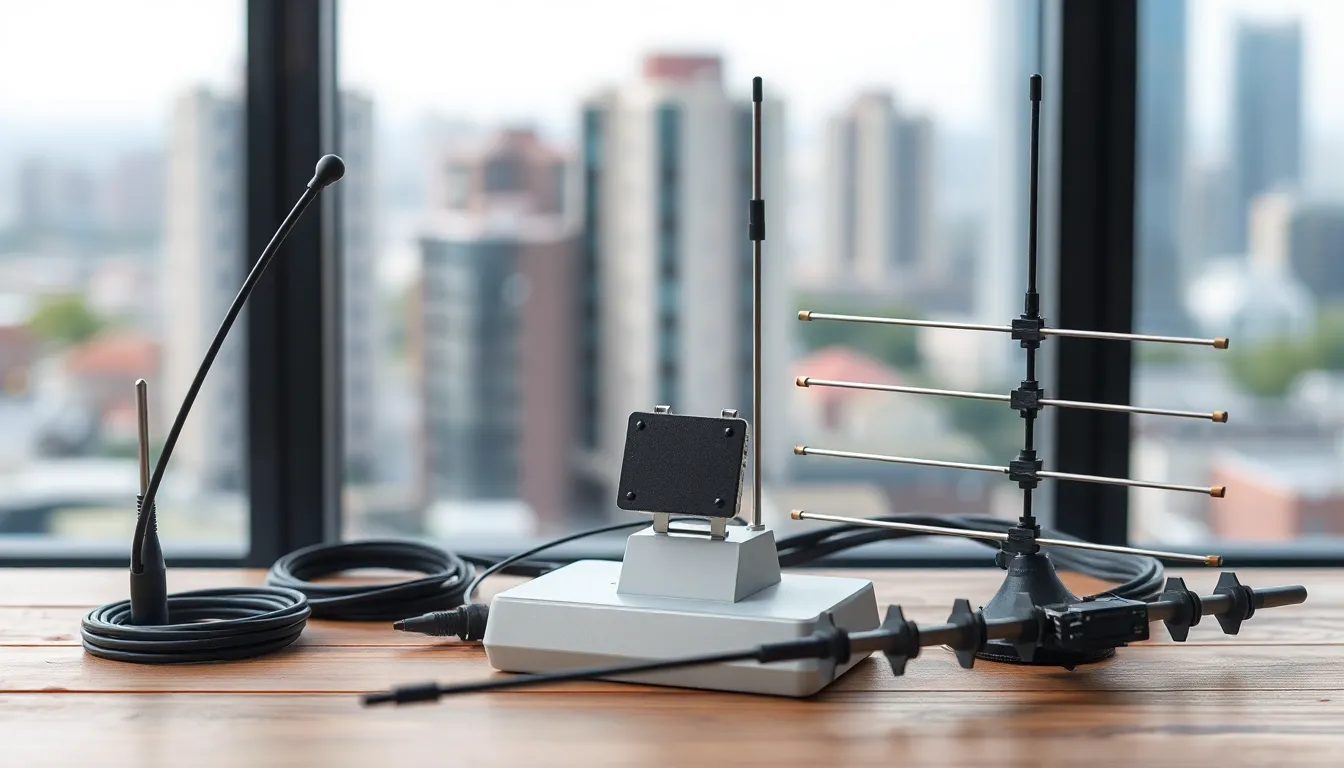
Mobile antennas come in various designs, each suited for different purposes. Understanding these types helps users select the best antenna for their needs.
Whip Antennas
Whip antennas are flexible and can bend without breaking. They excel in providing broad frequency coverage, making them ideal for portable devices. Often found in handheld radios and mobile phones, these antennas typically feature a simple design. Their length varies, often around one-half wavelength of the frequency used, which helps optimize performance. This type ensures reliable signal transmission, especially in urban areas where obstacles may hinder connectivity.
Patch Antennas
Patch antennas are compact and usually mounted on a flat surface. These antennas have a low profile, making them suitable for discreet installations in vehicles or buildings. They focus signals in a specific direction, enhancing gain and efficiency. Operating primarily in the microwave frequency range, patch antennas support applications like GPS and WLAN. Their lightweight design contributes to their popularity in modern wireless communication setups.
Yagi Antennas
Yagi antennas consist of multiple elements arranged along a horizontal plane. They deliver high directivity, which makes them advantageous for long-distance communication. Typically used for television reception and amateur radio, their design allows for superior signal strength in challenging environments. Adjusting the length and spacing of elements can optimize performance for specific frequencies. This type of antenna serves well in rural areas where signal strength often diminishes.
Factors Influencing Antenna Performance
Antenna performance hinges on multiple critical factors. Understanding these elements ensures mobile devices maintain connectivity and efficiency.
Frequency Range
Frequency range defines the bandwidth over which an antenna operates effectively. Each mobile antenna caters to specific frequency bands, impacting its performance. For instance, a 4G antenna typically ranges from 700 MHz to 2600 MHz, while 5G antennas may extend beyond 30 GHz. Signals outside these ranges diminish in quality, resulting in poor reception. Consequently, selecting an antenna that matches the intended frequency ensures optimal performance.
Gain and Directivity
Gain measures an antenna’s ability to focus energy in a particular direction. High-gain antennas amplify signals, enhancing reception and transmission in specific orientations. For instance, Yagi antennas offer substantial gain, making them ideal for long-distance communication. Directivity indicates how well an antenna concentrates signal power in desired directions. Antennas with higher directivity provide stronger signals at greater distances, essential for rural areas and improving overall connectivity.
Size and Form Factor
Size and form factor significantly affect antenna performance and installation flexibility. Larger antennas often yield better performance due to increased surface area, allowing for superior signal capture. However, compact form factors cater to portable applications without sacrificing functionality. This balance between size and efficiency is crucial for achieving optimal performance in various environments. Considerations include installation space and device design to ensure the chosen antenna meets operational requirements.
Applications of Mobile Antennas
Mobile antennas play a crucial role in various sectors, enhancing communication experiences through reliable connectivity.
Telecommunications
Telecommunication industries rely heavily on mobile antennas for effective signal transmission. These antennas ensure that mobile devices connect seamlessly to network towers, facilitating voice calls, text messages, and internet services. Furthermore, advancements in antenna technologies, such as MIMO, improve data throughput, allowing multiple users to interact without interruptions. With high-frequency bands being utilized for 4G and 5G networks, antennas now accommodate advanced communication needs. The integration of these technologies fosters faster internet speeds and improved user experiences across urban and rural landscapes.
Automotive
Automotive applications of mobile antennas focus on in-car connectivity and vehicle-to-everything (V2X) communication. These antennas enhance navigation, infotainment, and safety features by maintaining constant connections to networks. As cars incorporate advanced technologies like connected navigation systems, reliable antennas ensure real-time data exchange with traffic systems and other vehicles. Antennas designed for automotive use are often compact and durable, adhering to vehicle aesthetics while providing reliable signal quality. Enhanced connectivity within vehicles significantly contributes to improved driver and passenger experiences.
IoT Devices
IoT devices benefit immensely from mobile antennas, enabling seamless communication between interconnected gadgets. These antennas facilitate data exchange among smart devices, contributing to the efficacy of smart homes, wearables, and industrial IoT applications. Compact and efficient antennas optimize limited space in IoT devices, enhancing their performance in real-time data collection and transmission. With the rise of smart technologies, the demand for effective mobile antennas has increased to support the exponential growth in connected devices. Improved communication capabilities enhance automation and convenience in everyday activities.
Mobile antennas play an indispensable role in today’s communication landscape. Their ability to provide reliable signals ensures that users remain connected, whether for personal or professional needs. By understanding the various types of antennas and their specific applications, individuals and businesses can make informed decisions about their connectivity solutions.
As technology continues to advance, the importance of mobile antennas will only grow. Innovations like MIMO technology are set to enhance performance, making connectivity faster and more efficient. With the right mobile antenna, users can unlock the full potential of their devices, ensuring seamless communication in an increasingly connected world.